Blackberry Entremet
A restaurant-style multi-layer mousse cake with an almond dacquoise base, vanilla bavarois, blackberry mousse, and a deep purple mirror glaze. Serves 8–10. Two-day project: ~3 hours active on Day 1, ~45 minutes on Day 2.
Requires an 8” cake ring and acetate collar.
Components
Almond Dacquoise (base)
| Amount | Ingredient |
|---|---|
| 3 | egg whites |
| 75g | almond flour |
| 75g | icing sugar |
| 30g | granulated sugar |
| pinch | salt |
Vanilla Bavarois (middle layer)
| Amount | Ingredient |
|---|---|
| 500ml | whole milk |
| 4 | egg yolks |
| 100g | granulated sugar |
| 1 tsp | vanilla extract (or 1 vanilla bean) |
| 10g | powdered gelatin (or 5 gelatin sheets) |
| 200ml | heavy cream |
Blackberry Mousse (top layer)
| Amount | Ingredient |
|---|---|
| 400g | fresh blackberries |
| 150g | granulated sugar |
| juice of ½ | lemon |
| 10g | powdered gelatin (or 5 gelatin sheets) |
| 400ml | heavy cream |
Mirror Glaze
| Amount | Ingredient |
|---|---|
| 400g | fresh blackberries |
| 150g | granulated sugar |
| 60ml | water |
| 150g | glucose syrup |
| 6g | powdered gelatin (or 3 gelatin sheets) |
| 30ml | cold water (to bloom gelatin) |
To finish
| Amount | Ingredient |
|---|---|
| 150–200g | fresh blackberries |
Steps
Day 1
Dacquoise
- Preheat oven to 325°F (160°C). Line a baking sheet with parchment and trace an 8” circle as a guide.
- Sift almond flour and icing sugar together; set aside.
- Whip egg whites with salt to soft peaks. Gradually add granulated sugar and whip to stiff, glossy peaks.
- Fold in the almond flour mixture gently in two additions — don’t deflate.
- Pipe or spread into the 8” circle, about ¾” thick.
- Bake 20–25 minutes until lightly golden and set. Cool completely on the pan.
Vanilla Bavarois
- Bloom gelatin: sprinkle over 2 tbsp cold water and let sit 5 minutes.
- Whisk egg yolks and sugar until pale. Heat milk with vanilla until just steaming (do not boil).
- Slowly pour hot milk into yolks while whisking (tempering). Return to saucepan and cook over medium-low, stirring constantly, until the custard coats the back of a spoon (82°C / 180°F).
- Remove from heat. Melt the bloomed gelatin into the hot custard and stir until dissolved. Strain through a fine sieve and cool to room temperature (not cold — just not hot).
- Whip heavy cream to soft peaks. Fold into the cooled custard in two additions.
Blackberry Mousse
- Bloom gelatin: sprinkle over 2 tbsp cold water and let sit 5 minutes.
- Combine blackberries, sugar, and lemon juice in a saucepan. Cook over medium heat until berries break down (~10 minutes). Blend and strain through a fine sieve — you want a smooth, seedless purée. You should have about 300ml.
- Warm about a quarter of the purée in the saucepan, melt in the bloomed gelatin, then stir back into the rest of the purée. Cool to room temperature.
- Whip heavy cream to soft peaks. Fold into the cooled blackberry purée.
Assembly
- Place the dacquoise round on a flat surface (a cardboard cake round or a plate that fits in your freezer). Set the 8” ring around it and line the inside with an acetate collar.
- Pour in the vanilla bavarois to fill about half the ring. Tap gently to level. Freeze for 30–40 minutes until just firm enough to hold the next layer.
- Pour the blackberry mousse on top to fill the ring. Smooth the surface. Freeze overnight (minimum 6 hours — the colder the better for a clean mirror glaze).
Day 2
Mirror Glaze
- Bloom gelatin: sprinkle over the cold water and let sit 5 minutes.
- Combine blackberries, sugar, and 60ml water in a saucepan. Cook over medium heat until berries break down (~10 minutes). Blend and strain through a fine sieve — press well to extract as much juice as possible, discarding seeds and pulp.
- Return the strained juice to the saucepan and simmer over medium heat until reduced by about a third and deeply concentrated in color. You want roughly 200ml of liquid.
- Add the glucose syrup and stir to combine. Remove from heat and melt in the bloomed gelatin, stirring until fully dissolved.
- Use a hand blender to blitz until smooth, holding the blender at an angle to avoid bubbles. Strain once more through a fine sieve.
- Cool the glaze to 35°C (95°F) — this is critical. Too hot and it runs off; too cold and it sets before it covers. Use your thermometer.
Glazing
- Remove the entremet from the freezer. Unmold: run a hot towel briefly around the ring and lift it off. Peel away the acetate carefully.
- Set the frozen cake on a wire rack over a baking sheet to catch drips.
- Pour the glaze steadily over the center, letting it flow over the edges and down the sides. Do not touch it — one pass only. Let drips fall for a few minutes.
- Transfer to a serving plate or cake board. Refrigerate for at least 2 hours to thaw through before serving.
- Arrange fresh blackberries on top just before serving.
Notes
- The cake must be fully frozen when you glaze — the cold surface is what makes the glaze set instantly and gives the mirror finish.
- If the glaze cools past 35°C before you finish pouring, rewarm gently — don’t let it go above 40°C or the finish gets streaky.
- Leftover glaze can be refrigerated and remelted for another use.
- The assembled (unglazed) cake keeps in the freezer for up to 2 weeks. Glaze day-of serving.
- The fruit-based glaze is very slightly less mirror-shiny than a white chocolate glaze, but the natural deep purple color from the blackberry anthocyanins more than makes up for it.
- Blackberries from the field: taste and adjust sugar in the mousse and glaze — wild/garden berries can be more tart than store-bought.
- Glaze with platinum gelatin sheets: The recipe’s 3 sheets was not enough to set a proper mirror glaze — it poured more like a sauce. Either reduce the strained juice further (past a third — closer to half) before adding glucose, or increase to 4–5 platinum sheets. Platinum-grade sheets bloom stronger than gold but exact sheet weights vary by brand, making it hard to dial in without testing. Regardless, the sauce was delicious.
Makes
September 2026
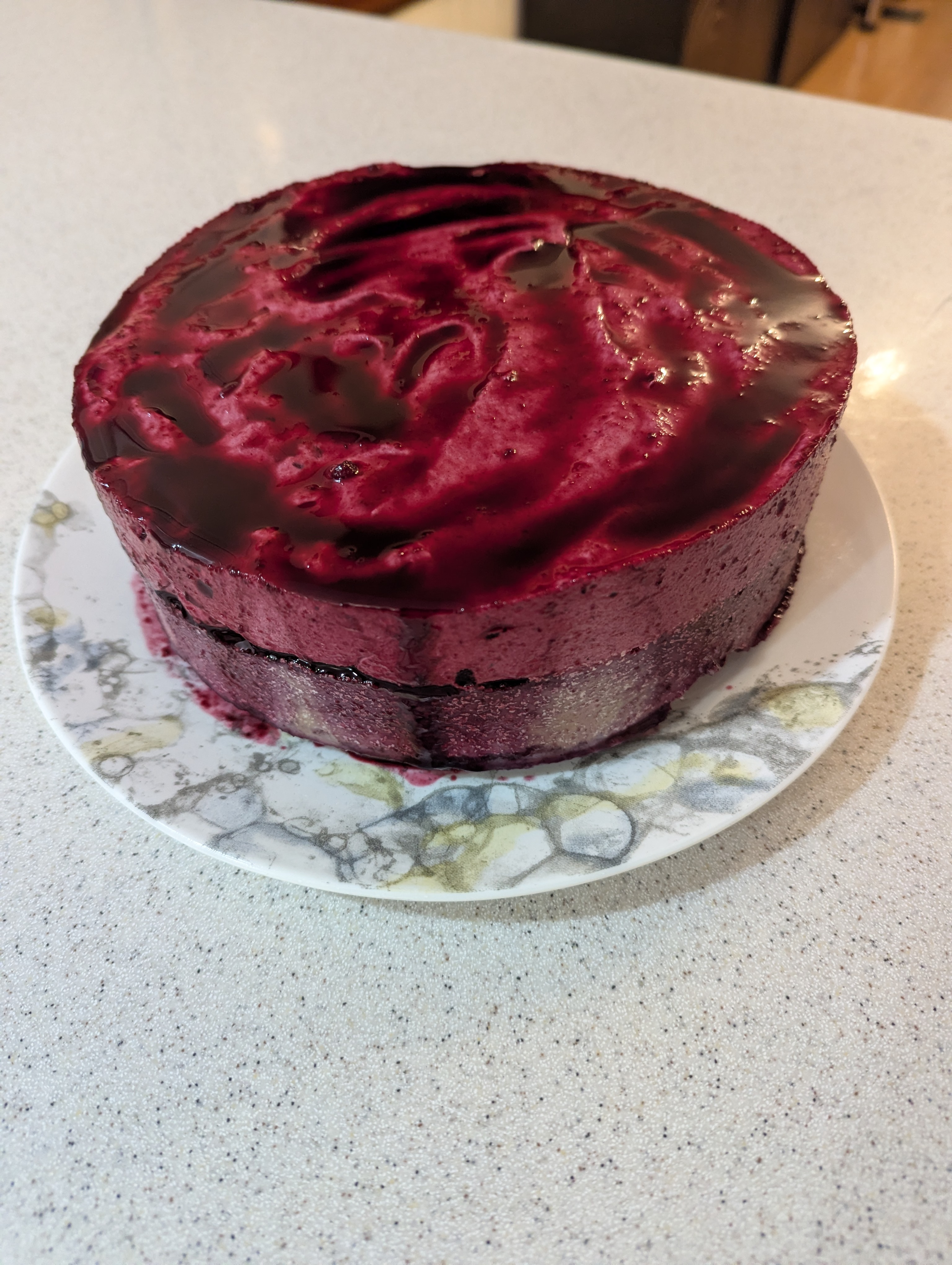
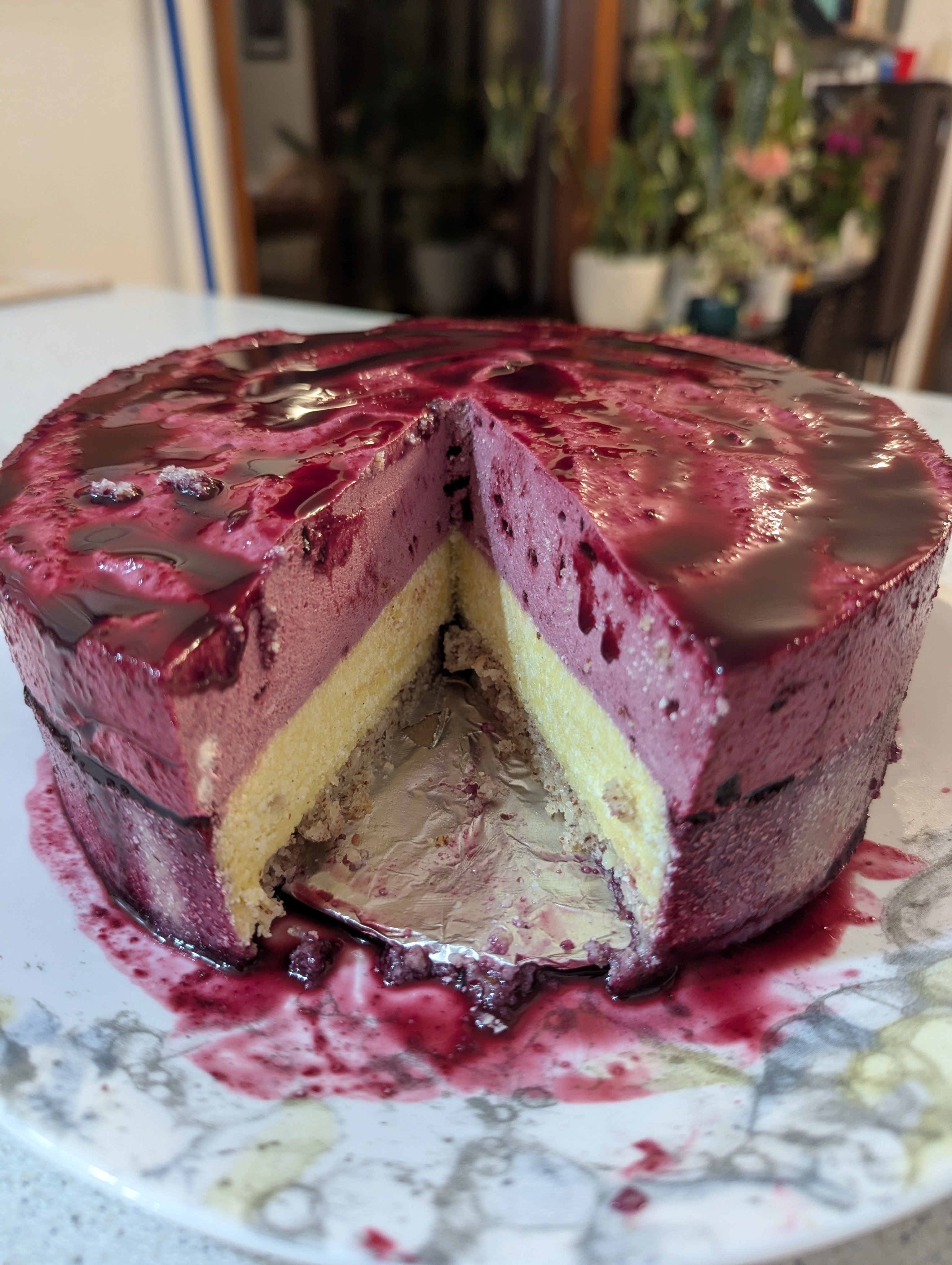
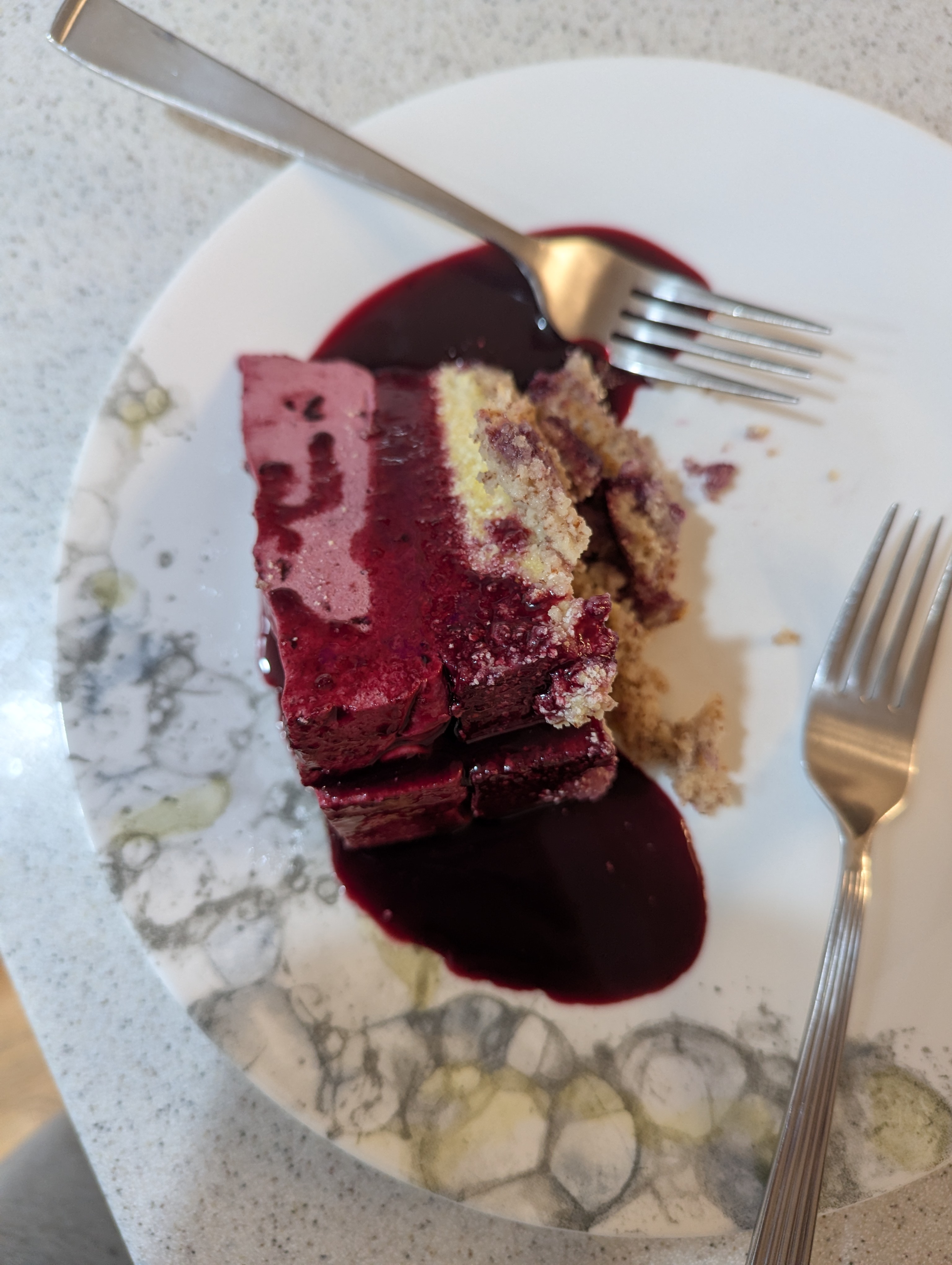
The glaze didn’t set to a true mirror — it ran off as a sauce rather than coating. Needed either more reduction before adding the glucose, or more gelatin sheets. Hard to judge with platinum sheets since sheet weights vary. The flavor was excellent regardless.