Monkey Puzzle Tree
Araucaria araucana — the centrepiece of the Monkey Puzzle Strip
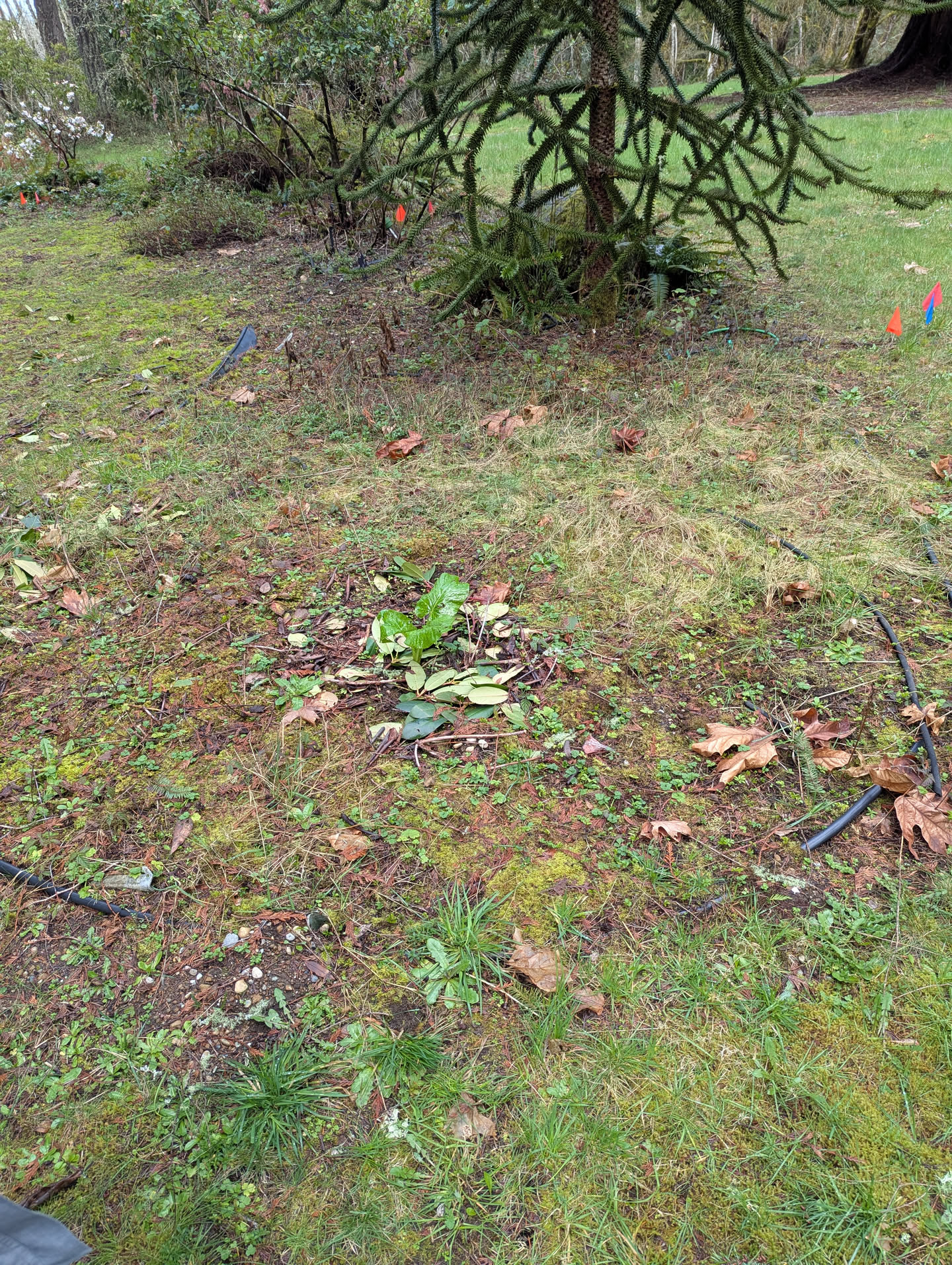
Photo: March 20, 2026 — view looking up through the Monkey Puzzle canopy, with an emerging Hosta or Hellebore rosette in the foreground lawn, drip irrigation line visible.
About
The Monkey Puzzle (Araucaria araucana) is a striking and ancient-looking conifer native to the Andes of Chile and Argentina. With its distinctive whorled branches covered in sharp, overlapping triangular scales, it is one of the most recognisable trees in any garden. This specimen anchors the strip that bears its name and has grown to a substantial size.
Key Characteristics
- Type: Evergreen conifer (not a true “puzzle” — it’s actually quite easy for monkeys to climb, despite the popular myth)
- Form: Broadly pyramidal when young, becoming umbrella-shaped with age
- Leaves: Rigid, sharp, triangular scales densely covering every branch — they last 10–15 years before dropping
- Bark: Dark grey, wrinkled, and rope-like on mature specimens
- Cones: Large (up to 15 cm), barrel-shaped; male and female cones on separate trees (dioecious)
- Height: Can reach 25–30 m at maturity; slow-growing
Care Notes
| Aspect | Details |
|---|---|
| Hardiness | Hardy to around −20°C (USDA Zone 7); well-suited to the Pacific Northwest |
| Soil | Prefers well-drained, moderately fertile soil; tolerates a range of pH |
| Sun | Full sun to light shade |
| Watering | Established trees are drought-tolerant; drip irrigation supports young growth |
| Pruning | Virtually none required — do not cut the leading shoot; lower branches naturally die back as the tree ages |
| Fertilising | Not generally needed for established specimens |
| Pests | Generally trouble-free; aphids can occasionally affect young growth |
Notes
- A protected species in Chile — in the garden it is purely ornamental
- The edible seeds (piñones) were a staple food for the Pehuenche people
- Patience required: grows only 20–30 cm per year
- The area under and around the tree is ideal for shade-tolerant ground covers — Arum italicum has naturalised here